
Brazilian comércio exterior is running its last hybrid cycle: the Receita Federal keeps publishing schedules that switch off the Declaração de Importação while the DUIMP becomes the single import declaration. For a small or medium brokerage, the question is no longer “is the DUIMP better?”, but “what do I migrate first, and what still runs on DI until the shutdown?”.
This comparison puts both models side by side under the criteria that actually hit margin: retyped fields, Product Catalog dependency, LPCO handling, parameterization timing, tax calculation and rework cost.
DI and DUIMP: what actually changes in the broker’s routine
The DI is document-centric. Each shipment restarts: data is typed into adições, a Licença de Importação is requested when there is anuência, and parameterization only happens after registration. The product data lives inside the declaration and dies with it.
The DUIMP is data-centric. The product is registered once in the Catálogo de Produtos, with NCM and attributes defined by the Receita Federal and the órgãos anuentes, and is reused in every operation through the Portal Único de Comércio Exterior.
That single change moves the effort from the declaration moment to the registration moment — which is exactly why migration feels heavier at the beginning and lighter at every recurring shipment afterwards.
Comparison table: DI vs DUIMP across 7 operational criteria
| Criterion | DI (legacy Siscomex) | DUIMP (Portal Único) |
|---|---|---|
| Data entry per process | Full retyping in every adição | Catalog reuse; only shipment data is new |
| Product Catalog | Not required | Mandatory, with fiscal attributes |
| Licensing | LI, usually prior and sequential | LPCO, anticipated and parallel to the declaration |
| Parameterization | After registration, close to arrival | Anticipated, with earlier risk signalling |
| Tax calculation | Per adição, manual conference | Calculated from registered attributes |
| NCM error cost | Rework in each declaration | Fixed once in the catalog, propagated |
| Learning curve | Low — known routine | High at the start, decreasing per client |
In practice, a recurring importer with 40 SKUs retypes those 40 items in every DI. In the DUIMP, they are registered once and consumed indefinitely — the difference compounds month after month.
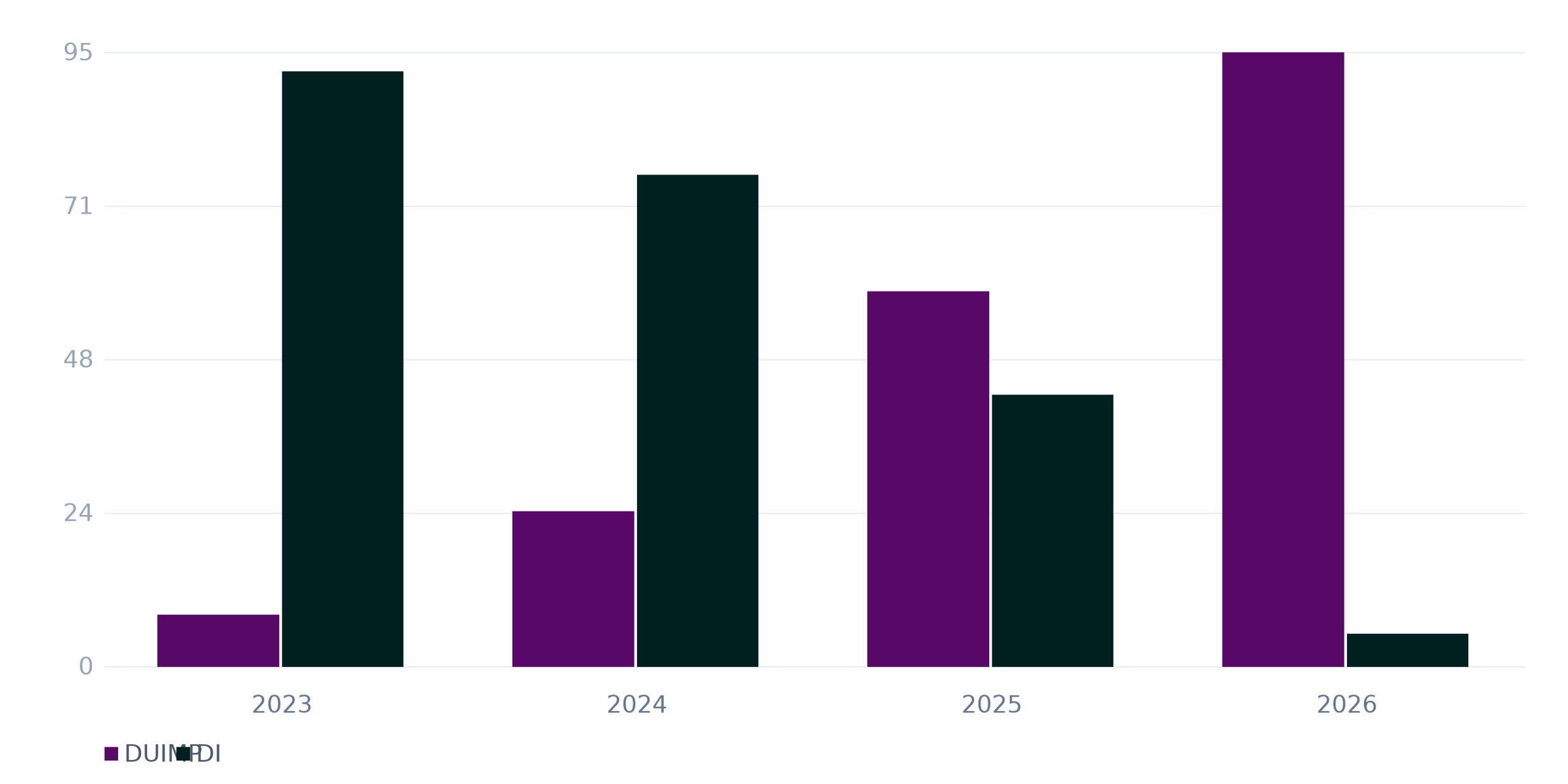
DI: pros, cons and what still keeps it alive in 2026
Where the DI still wins
- Zero preparation: no catalog, no attributes, no operator registration.
- Known routine: the team already masters adições, LI and desembaraço aduaneiro.
- One-off operations: for an importer who ships once a year, the front-loaded DUIMP effort has little payback.
Where the DI costs you money
- Flat, repetitive cost per process — effort never decreases.
- Typing errors appear late, at parameterization, when correction is expensive.
- No structured data to feed tax reform scenarios (CBS/IBS) or audits.
- A deadline: the shutdown schedule removes the option, NCM by NCM and regime by regime.
DUIMP: pros, cons and the Product Catalog learning curve
Real gains
- Product registered once, reused in every shipment and in the DU-E logic for exports.
- Anticipated parameterization and earlier visibility of risk.
- Automatic tax calculation from attributes, reducing manual conference.
- Consistent data for compliance aduaneiro, OEA and future audits.
The real barrier
The barrier is not the declaration — it is populating and maintaining the Catálogo de Produtos. Attributes change by NCM, the importer sends inconsistent spreadsheets, and the broker ends up doing the importer’s data work for free.
That is where most small brokerages stall. A deeper breakdown of this effort is available in our analysis of the real cost of the DUIMP across three migration paths.
LPCO, anuentes and parameterization: where the two models diverge most
Under the DI, licensing is sequential: the LI comes first, the declaration comes after, and any divergence restarts the clock. Under the DUIMP, the LPCO can be requested in parallel and anticipated with the órgãos anuentes, shortening the critical path.
Parameterization also moves forward. Instead of discovering a red channel with the container already at the terminal, the broker sees the risk signal earlier and can act before storage charges accumulate — a decisive point for anyone comparing DI and DUIMP across the seven criteria that decide the operation.
Migration cost: hidden effort, rework and team time
| Scenario | Initial effort | Effort per recurring shipment | Payback |
|---|---|---|---|
| Stay on DI until forced | None | High and constant | Never — ends in emergency migration |
| Gradual migration by client | Medium | Decreasing | 3 to 6 months for recurring importers |
| Full migration with automated catalog | Concentrated, short | Low | Fastest, if document extraction is automated |
The hidden cost is rarely the software. It is the team hours spent transcribing Invoice and Packing List into catalog fields, and the rework generated by a wrong classificação fiscal replicated across dozens of processes.
Verdict: which model to prioritize by brokerage profile
- Brokerage with recurring importers and stable SKUs: migrate now. The catalog pays itself back fastest and the gain is permanent.
- Brokerage with spot operations and varied clients: migrate by NCM, following the official schedule, keeping DI alive where it is still accepted.
- Brokerage operating in the Manaus Free Trade Zone: plan the DUIMP alongside the PLI and DAI flows, which have their own specifics in Amazonas.
- Brokerage without an IT team: the decisive criterion is not the model, but whether the system runs DI, DUIMP and DU-E in parallel without duplicating work.
For a profile-by-profile breakdown, see our verdict by brokerage profile.
How Coda AI and Sigraweb handle DI, DUIMP and DU-E in parallel
Running both models during the 2026 schedule is inevitable. Sigraweb keeps DI, DUIMP and DU-E in the same environment, with integration to Siscomex and the Portal Único, so the team does not maintain two parallel routines.
The heaviest part — the catalog — is absorbed by Coda AI, which reads Invoice, Packing List and other commercial documents and converts them into structured data: description, NCM, attributes and fiscal classification ready for the Catálogo de Produtos. The entry barrier of the DUIMP stops being a typing marathon.
Frequently asked questions
When does the DI shutdown actually finish?
The Receita Federal is switching off the DI progressively, by NCM, regime and anuente flow, with consolidation expected along 2026. Until then, DI and DUIMP coexist.
Can I register the DUIMP without the Product Catalog?
No. The DUIMP consumes product data registered beforehand. Without a catalog with correct NCM and attributes, the declaration cannot be completed or correctly taxed.
Does the DUIMP change anything in the Manaus Free Trade Zone?
Yes. Amazonas operations combine the DUIMP with PLI and DAI flows, so the migration plan must consider the Suframa layer, not only the federal schedule.
What should a small brokerage migrate first?
Start with recurring importers and stable SKUs. They generate the fastest return on catalog effort and validate the routine before the mandatory deadline arrives.
Next step: map your top five recurring importers, list their SKUs and request a Sigraweb demonstration to see Coda AI turning commercial documents into a ready Product Catalog — before the schedule decides for you.