Few decisions in comércio exterior weigh as much right now as choosing when to stop filing Declaração de Importação (DI) and start filing DUIMP. Both still coexist in 2025 and 2026, and that coexistence is exactly what creates operational risk for small and medium customs brokerages.
This is not another article explaining what the Declaração Única de Importação is. It puts DI and DUIMP side by side as two real operating options, measures effort and risk, and delivers a verdict for teams that cannot stop the operation to migrate.

DI vs DUIMP: why comércio exterior still runs on two paths
The DI is a documental, sequential declaration filed in the legacy Siscomex, organized by adições and dependent on Licença de Importação (LI) when licensing applies. The data lives inside each declaration and is retyped, process after process.
The DUIMP is data-oriented. It consumes the Catálogo de Produtos, with NCM and attributes registered beforehand, replaces LI with LPCO before the órgãos anuentes, connects to the CCT and allows registration before cargo arrival inside the Portal Único de Comércio Exterior.
That difference is structural. Migration is not switching screens: it is moving the moment of truth from the registration desk to the product registry. The Receita Federal timeline for the gradual shutdown of the DI only accelerates a change that is already technical.
Side-by-side comparison: DI and DUIMP across 10 criteria
| Criterion | DI (legacy Siscomex) | DUIMP (Portal Único) |
|---|---|---|
| Data model | Documental, by adição | Data-oriented, by product item |
| Product registry | Optional, informal | Catálogo de Produtos mandatory |
| Licensing | LI / substitutive LI | LPCO with órgãos anuentes |
| Filing moment | After cargo arrival | Allowed before arrival (anticipated) |
| Cargo control | Manual conciliation | Integrated with CCT |
| Tax calculation | Manual, per adição | Automatic, per item |
| Amendments | Retificação with formal steps | Versioning of the declaration |
| Parametrização | Channels after registration | Risk analysis with anticipated data |
| Typical error | Typing and transcription | Registry and attribute inconsistency |
| Expiration | Scheduled shutdown | Single path ahead |
Read the last two lines together. The DUIMP removes repetitive typing, but it propagates registry errors to every declaration of that importer. That is why compliance aduaneiro and attribute-level review gain weight in the new model.
Staying on DI a little longer: pros, cons and the real expiration date
What still works in favor of the DI
- The team already knows the flow, the checklists and the usual objections from the aduana.
- Some regimes, modais and administrative treatments are still being transferred by waves.
- No immediate investment in cataloguing products or reviewing classificação fiscal.
What makes it expensive
- The shutdown date is not negotiable. Waiting means migrating under pressure, with cargo at the terminal and demurrage running.
- Every DI filed keeps feeding a registry that will not be reused in the DUIMP.
- The brokerage loses the learning curve it could be building on real, low-risk processes.
If you are still weighing the calendar, the analysis in the 2026 DUIMP timeline without trauma shows how the waves reach different operations at different moments.
Moving to DUIMP now: pros, cons and what the Catálogo de Produtos demands
The gains appear in the second month
- Anticipated registration: LPCO, attributes and classificação fiscal resolved before shipment.
- Automatic tributação na importação per item, reducing formal errors and retificações.
- Versioning instead of heavy amendment procedures.
- A clean database ready for classificação fiscal automatizada and predictive risk analysis.
The real cost: registry quality
The hard part is not the interface. It is NCM, attributes, product codes, supplier data and unit of measure. A brokerage that cleans this registry in advance migrates in weeks; one that waits migrates in crisis mode.
Our field reading of small and medium operations shows a consistent pattern: the more product items are catalogued before the first DUIMP, the shorter the transition and the lower the rework.
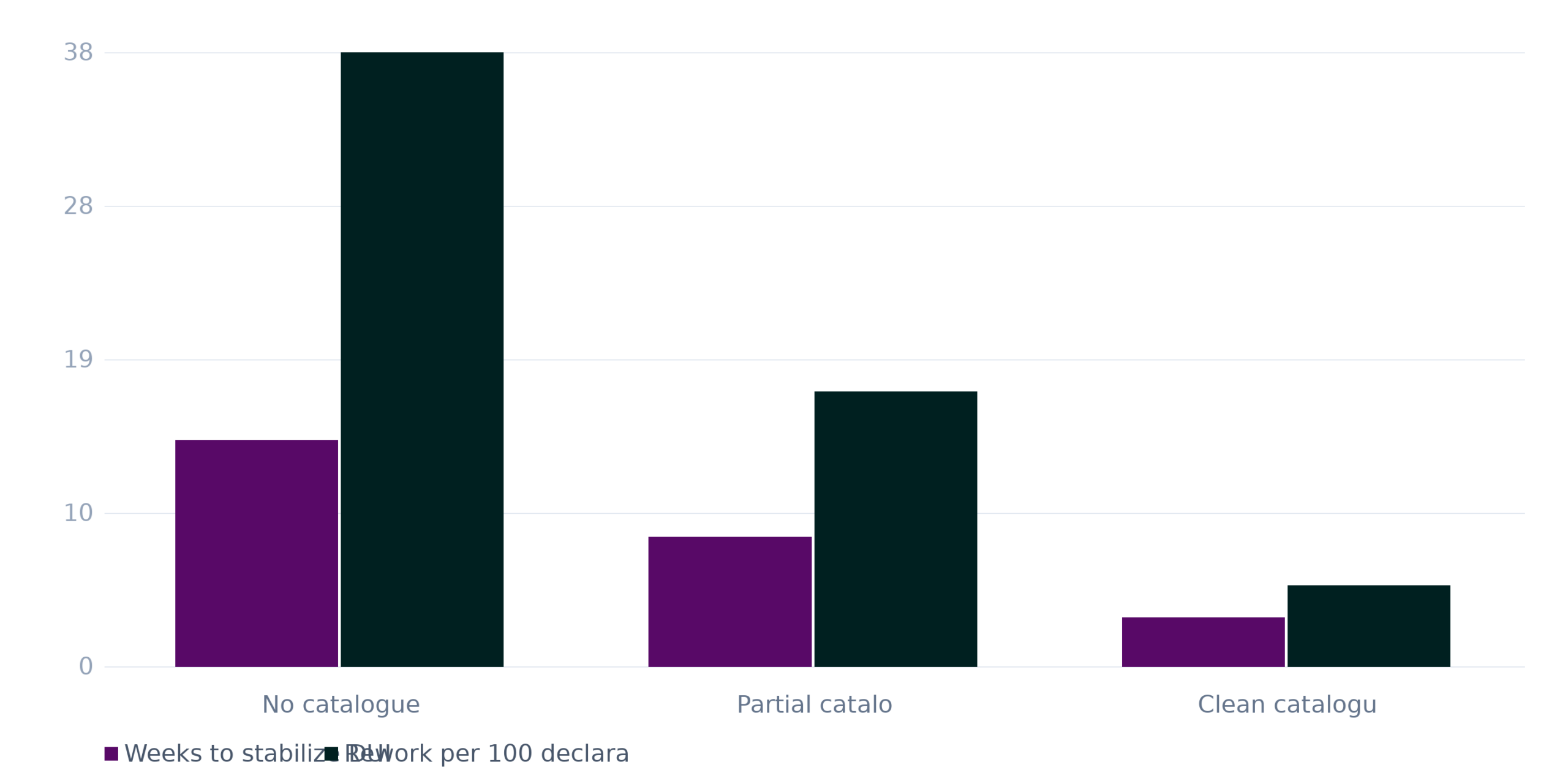
The practical lesson: registry work done calmly costs a fraction of registry work done with cargo stopped. The step-by-step view in the three routes to build your Catálogo de Produtos helps size that effort.
Cost, time and risk for a small or medium brokerage
Coexistence is not neutral. Keeping DI and DUIMP flows in parallel duplicates checklists, doubles training time and confuses the importer, who receives two different document requests for similar cargo.
| Scenario | Preparation time | Main risk | Impact on the team |
|---|---|---|---|
| Migrate now, with pilot processes | 4 to 8 weeks | Controlled learning curve | Gradual, planned hours |
| Migrate halfway through the timeline | 8 to 14 weeks | Registry gaps under deadline | Overtime and double flow |
| Migrate at the DI shutdown | Emergency | Stopped cargo, demurrage, penalties | Operation in crisis mode |
Risk also changes nature. In the DI, the classic penalty came from typing and documental divergence. In the DUIMP, it comes from an attribute filled wrong once and repeated across dozens of declarations — a compliance problem, not a clerical one.
Verdict: which path fits your operation
For the vast majority of small and medium brokerages, the verdict is direct: migrate now with pilot processes and a clean registry. Stay on DI only for operations whose regime or modal has not yet been transferred, and only while that is technically true.
The decision that separates organized offices from the ones running behind is one line on the calendar: set an internal cutoff date earlier than the official one. Choose one recurring importer, with stable products and no licensing complexity, and make it your first full DUIMP cycle.
If you want to compare the decision criteria in more depth, see the DI versus DUIMP comparison that decides your operation and the three migration routes to DUIMP.
Migration checklist
- Map which regimes, modais and órgãos anuentes already accept DUIMP for your portfolio.
- Extract the product base of your top three importers and review NCM and attributes.
- Fill the Catálogo de Produtos and validate operator and manufacturer data.
- Convert LI routines into LPCO routines with each anuente.
- Run one pilot DUIMP end to end, including CCT conciliation and tax review.
- Publish an internal cutoff date and freeze new DI flows after it.
- Retrain the team on attribute review instead of field-by-field typing.
How automation shortens the DI-to-DUIMP transition
Tools decide the pace. A 100% cloud platform that handles DI, DUIMP, DU-E and Zona Franca de Manaus regimes in the same environment lets you migrate without interrupting what still runs on DI.
Add intelligent reading of Invoice and Packing List, native integração com Siscomex and the Portal Único, and attribute validation before registration: the registry stops being a bottleneck and becomes an asset for the reforma tributária scenario ahead.
Frequently asked questions
Can I still file a DI in 2026?
Only for operations whose regime, modal or administrative treatment has not yet been transferred to the DUIMP. The Receita Federal shutdown is gradual, so availability shrinks wave by wave until the DUIMP becomes the single path.
What replaces the Licença de Importação in the DUIMP?
The LPCO, requested inside the Portal Único directly with the órgãos anuentes. It is linked to the DUIMP items and can be obtained before shipment, which is one of the main gains of anticipated filing.
Is the Catálogo de Produtos mandatory?
Yes. Every DUIMP item must point to a catalogued product with NCM and the attributes required for that code. Registry quality defines how fast and how safely your declarations clear.
How long does migration take for a small brokerage?
With a reviewed product registry and pilot processes, four to eight weeks is realistic. Without registry preparation, the same transition can stretch beyond three months and collide with the deadline.
Next step: pick one importer, clean its product registry this month and run your first pilot DUIMP. Talk to the Sigraweb team to see how a single cloud environment keeps DI and DUIMP running side by side until your internal cutoff.